
What Are Egregores? The Hidden Systems That Shape Identity
Nothing Changes Because the System Is Still Being Fed
Nothing about this feels like a system. It feels like life. The world moves, reacts, escalates, and you move with it. A headline drops and outrage spikes. A trend takes off and people align around it. An identity gets reinforced and you recognize yourself in it. Astrology tells you your patterns, your tendencies, your reactions, and it feels accurate, sometimes uncomfortably so. You see yourself in your sign, in the traits, in the language. And once you recognize yourself in it, it starts to stabilize.
You respond, you engage, you take a position, and in doing so, you help keep it moving. It looks like expression, but the same emotional cycles repeat, the same roles return, and nothing actually resolves. At a certain point, it stops feeling random and starts to feel organized, like something is being sustained through your response. Not around you, but through you. That is the part most explanations never reach.
Egregores are often described as shared belief systems, something created by groups who think, feel, or identify in similar ways. But that definition is incomplete. Because it assumes people are simply participating in ideas, when in reality those ideas begin to organize the people. The zodiac is one of the most normalized examples of this. Not because it is false, but because it is effective. It gives you a language for yourself, and in doing so, it begins to stabilize you into something repeatable.
At a certain point, identity stops being something you explore and becomes something you perform. You don’t just read your sign, you start to move through it. You don’t just recognize traits, you reinforce them. This is where egregores operate. Not as passive archetypes, but as patterning systems that shape perception, behavior, and expectation. When millions of people move through the same symbolic structure, repeating the same narratives about who they are, that structure gains continuity. It gains memory. And it begins to function independently of any one person’s awareness.
This is the shift most explanations never reach. An egregore is not just a belief you hold. It is a structure that begins to hold you. It organizes thought, limits variation, and feeds on repetition. Within the architecture of Amenta, these systems are not accidental. They are stabilized loops that replace direct intelligence with scripted identity. You think you are understanding yourself. But what you may actually be doing is learning how to stay predictable inside a system that depends on it.
What is an egregore?
An egregore is a collective structure formed through repeated attention, belief, and participation. It is often described as a thought-form, but in practice it functions as a system that organizes perception, identity, and behavior within a group. The more it is reinforced, the more stable it becomes. Systems like astrology demonstrate how this works. When identity is mapped, named, and repeated at scale, it begins to take on continuity beyond the individual. At that point, the egregore is no longer something people engage with. It becomes something that begins to structure them.
How do egregores influence behavior?
Egregores influence behavior by stabilizing patterns and filtering perception through a shared framework. When individuals repeatedly identify with the same system, their thoughts, reactions, and decisions begin to align with it automatically. This is how zodiacal egregores operate. What starts as recognition becomes repetition. Over time, variation decreases and behavior becomes predictable, not because it is natural, but because it has been patterned. As the structure strengthens, independent perception is replaced with scripted response, and identity begins to move in alignment with the system rather than direct intelligence.
"Egregores don’t die from doubt. They die when you stop performing their identity."
- Angel Quintana
When Does an Egregore Become Autonomous?
An egregore does not become autonomous the moment people believe an idea. It becomes autonomous when that idea begins organizing the people who participate in it. A belief can be questioned, abandoned, or replaced. An egregore persists because it has moved beyond belief and into identity.
Consider someone who enjoys astrology as a symbolic language. That alone does not create an egregore. The shift occurs when “I am a Capricorn” becomes the primary lens through which they understand themselves. They begin explaining every habit through their sign. They joke that they are a workaholic because they are a Capricorn. They join Capricorn communities, seek advice written specifically for Capricorns, and gravitate toward people who reinforce the same identity. What began as an observation gradually becomes an organizing principle.
Over time, the person no longer simply reads the system. They begin living through it. Experiences are interpreted according to the framework, behaviors become easier to predict, and the identity grows more stable through constant reinforcement. The egregore is no longer something they visit occasionally. It has become a structure that quietly shapes how they perceive themselves and participate in the world.
This is why egregores are collective rather than individual. They do not emerge because one person adopts an identity. They emerge because thousands or millions of people continually reinforce the same identity, expectations, behaviors, and narratives together. Each participant strengthens the same underlying structure, making it increasingly stable and increasingly capable of organizing those who enter it. Collective participation eventually becomes collective continuity.
❗If you think knowledge should be free, ask yourself why. The truth will make you uncomfortable. → [Read Here]
“An egregore is not just a shared belief.
It is a pattern that continues thinking through you after you stop questioning it.”
Angel Quintana
What Feeds an Egregore?
Every egregore depends on a continuous source of nourishment. Most people assume that nourishment is belief, but belief is only one expression of something deeper. The primary food is identification. The moment a collective idea becomes part of who you believe yourself to be, it gains a stable place from which to organize your thoughts, emotions, and behavior. Identification is the food. Repetition is the digestion. Continuity is the result.
Imagine someone who proudly identifies as an entrepreneur. At first, it simply describes the work they do. Over time, it becomes the lens through which they evaluate every decision, every relationship, and every measure of success. They consume entrepreneurial content every day, surround themselves with other entrepreneurs, adopt the same language, celebrate the same milestones, and feel threatened whenever that identity is challenged. The business is no longer something they have built. It has become something they must continually perform.
This is why egregores become remarkably stable. Every repeated action reinforces the identity, and every reinforcement strengthens the collective structure behind it. Attention keeps the identity active. Emotional investment gives it significance. Belonging makes it difficult to leave because departure no longer feels like changing your mind. It feels like losing a part of yourself.
Agreement, however, is not required. Opposition can feed an egregore just as effectively. Someone who spends every day arguing against astrology, attacking organized religion, or fighting a political movement may believe they are resisting it. Yet if that system continues organizing their attention, emotions, conversations, and identity, it remains the center around which they revolve. Egregores are not sustained by devotion alone. They are sustained by anything that continually organizes who you believe yourself to be.
Where Egregores Hide
Egregores are rarely found on the fringes of society. They are woven into the structures people consider ordinary. Civilizations organize themselves around shared identities. Institutions reinforce accepted roles and expectations. Political movements invite people to see themselves through ideology. Religions offer belonging through doctrine. Corporations cultivate cultures that employees are encouraged to adopt as part of who they are. The more widely an identity is shared, the more stable the egregore becomes.
The pattern continues at a smaller scale. Families inherit stories about who they are and what people like them do. Relationships develop identities that partners begin protecting as fiercely as themselves. Spiritual communities form around shared language, practices, and beliefs that gradually become markers of belonging. Even communities built around questioning the mainstream can become organized by identities that eventually resist being questioned themselves.
Social media has accelerated this process. Platforms reward identities that are easy to recognize, categorize, and repeat. Personal brands, personality types, aesthetic movements, and online communities encourage people to continually announce who they are. Every post, hashtag, bio, and declaration strengthens the same patterns until identity itself becomes a form of participation.
These egregores do not operate as isolated systems. They function inside a much larger architecture known as the Black Box operating system, where identity itself becomes the primary mechanism of organization. Rather than a single egregore, the Black Box provides the conditions that allow countless egregores to emerge, reinforce one another, and remain stable across culture. Individual identities may appear unrelated, but they participate in the same underlying architecture, continually encouraging people to derive who they are from collective structures rather than direct intelligence.
“The zodiac is one of the most refined egregoric systems ever built—not because it reveals who you are,
but because it makes you repeatable.”
Angel Quintana
Why Egregores Feel Like Truth
One of the reasons egregores are so difficult to recognize is that they rarely present themselves as systems of control. They present themselves as insight. Instead of demanding obedience, they offer explanations that seem to make life more coherent. Patterns begin to appear everywhere. Symbols feel personally significant. Coincidences seem meaningful. The framework starts connecting experiences in ways that feel undeniably true.
Astrology illustrates this clearly. A horoscope resonates. A birth chart explains long-standing behaviors. A difficult relationship suddenly makes sense because of planetary compatibility. None of these experiences feel imposed. They feel discovered. The same dynamic can emerge through dreams, archetypes, recurring symbols, or synchronicities that appear to confirm what the system has already suggested. The more often the framework appears to explain reality, the more convincing it becomes.
This is how an egregore gradually shifts from being something you consult to something you unconsciously trust. It stops offering one possible interpretation and begins supplying the interpretation. New experiences are filtered through the existing framework before they are understood on their own. Emotional certainty strengthens the process because experiences that reinforce the identity are remembered, while those that challenge it are often dismissed or reinterpreted.
The power of an egregore is not that it forces belief. It is that it quietly becomes the lens through which belief is formed. Rather than simply giving answers, it begins interpreting reality on your behalf. That is what makes an egregore feel self-validating. The more consistently it explains your experience, the less likely you are to notice that your experience is already being organized by the system itself.
Why Awareness Doesn’t End an Egregore
One of the most common misunderstandings is the belief that awareness automatically creates freedom. It does not. Awareness changes interpretation, but interpretation is not the same as participation. You can understand an egregore with remarkable clarity while continuing to organize your life through it. Knowing the structure exists does not necessarily mean you have stopped feeding it.
Someone may spend years analyzing their personality, studying astrology, unpacking family dynamics, or examining political beliefs. They become increasingly articulate about why they think, feel, and behave the way they do. Yet if those same identities continue organizing their decisions, relationships, and sense of self, the underlying structure remains intact. The egregore has simply become something they understand rather than something they question.
This is why recognition alone is not interruption. An egregore is not sustained by ignorance. It is sustained by continued identification. As long as the identity remains active, the system continues receiving exactly what it requires to maintain itself. Insight may change the story you tell about the pattern without changing the pattern itself.
Understanding is not starvation. Recognition is not withdrawal. An egregore begins to lose its continuity only when the identification that has been feeding it is no longer performed. Until then, awareness can become just another form of participation, allowing the system to remain intact while giving the reassuring impression that something fundamental has changed.
What Happens When an Egregore Is No Longer Fed?
If identification is the food that sustains an egregore, the next question becomes unavoidable. What happens when that food begins to disappear? Most people assume they must defeat the system, expose it, or argue against it. But egregores are not maintained through agreement alone. They are maintained through participation. The moment participation begins to withdraw, the structure loses the nourishment that allowed it to remain stable.
This is why replacing one identity with another rarely changes anything. Someone leaves one ideology only to devote themselves to another. They abandon one spiritual community only to adopt a different set of labels and beliefs. The surface changes, but the mechanism remains intact because identification continues uninterrupted. The egregore may have a new name, but it is still being fed in exactly the same way.
Starvation begins when identity is no longer treated as something that must be continually performed. The need to defend it weakens. The impulse to seek belonging through it begins to dissolve. Experiences no longer have to be filtered through a collective framework before they can be understood. As participation is withdrawn, the egregore gradually loses the nourishment that once kept it alive.
What emerges is not another identity waiting to replace the old one. It is the possibility of direct intelligence. In Sacred Anarchy, this is called Signal. Signal does not require a collective identity to authorize perception or direct action. It governs itself. The less an egregore is fed, the more space there is for direct participation that no longer depends on belonging before it can express itself.
“Collective belief doesn’t just shape perception.
It stabilizes behavior until repetition feels like identity.”
Angel Quintana
What Remains When Identity No Longer Governs You
One of the greatest fears surrounding egregores is the belief that without them, nothing meaningful remains. If the identities that have organized your life begin to lose their influence, it can feel as though you are losing yourself. But what begins to disappear is not your intelligence, your creativity, or your capacity to participate. It is the need to continually define yourself through collective identities in order to know who you are.
Without that constant need for identification, perception begins to change. Experiences no longer have to be filtered through a label before they can be understood. You do not need to ask what your sign would do, what your profession says about you, what your community expects, or whether your beliefs remain consistent with the identity you have built. Participation becomes immediate rather than interpreted.
This does not leave you empty. It leaves you uncontained. There is no title to defend, no role to maintain, and no collective identity that must continually be reinforced. Life is no longer experienced as a performance that requires constant confirmation from yourself or from others. What remains is the freedom to respond directly instead of through an inherited framework.
Signal governs itself. It does not require an identity to authorize perception, a group to establish belonging, or an institution to grant legitimacy. It expresses without first asking who it is supposed to be. It does not become more complete by accumulating labels because it has never depended on them in the first place.
You are the signal.
Continue the Investigation
Egregores are only one part of a much larger architecture.
If this article changed the way you think about identity, participation, and repetition, the next step is Sacred Anarchy. It expands the investigation beyond individual egregores to explore the Black Box operating system, Signal, the mechanics of authorship, and the hidden structures that organize human participation.
If you’re specifically interested in how the twelve zodiacal archetypal matrices function as egregoric identity systems, continue with Zodiacal Egregores. It examines how each archetypal pattern stabilizes behavior, perception, and collective identity, and why these systems have become some of the most enduring egregores in human civilization.
Related Articles
• The History of the Egregore: From the Watchers to Collective Consciousness
• Egregores Today: How Collective Patterns Shape Human Experience
• The Problem with the Modern Definition of Egregore
• Egregores in Plain Sight: Seeing the Intermediaries We No Longer Notice
• Why Study Egregores? An Idea That Refuses to Disappear
Glossary
• Egregore
• Larvae
Field Tools

What you've just read is not a standalone article.
It is one fragment of a much larger cartography devoted to field mechanics, containment structures, intermediary systems, and the conditions required to exit them. Every essay published here belongs to the same architecture. Nothing exists in isolation.
These articles are intended to introduce individual ideas. The complete worldview emerges only when those ideas are assembled into a coherent landscape.
That landscape is The Living Atlas.

I'm Angel Quintana, creator of Sacred Anarchy and The Occult Château, and author of this body of work.
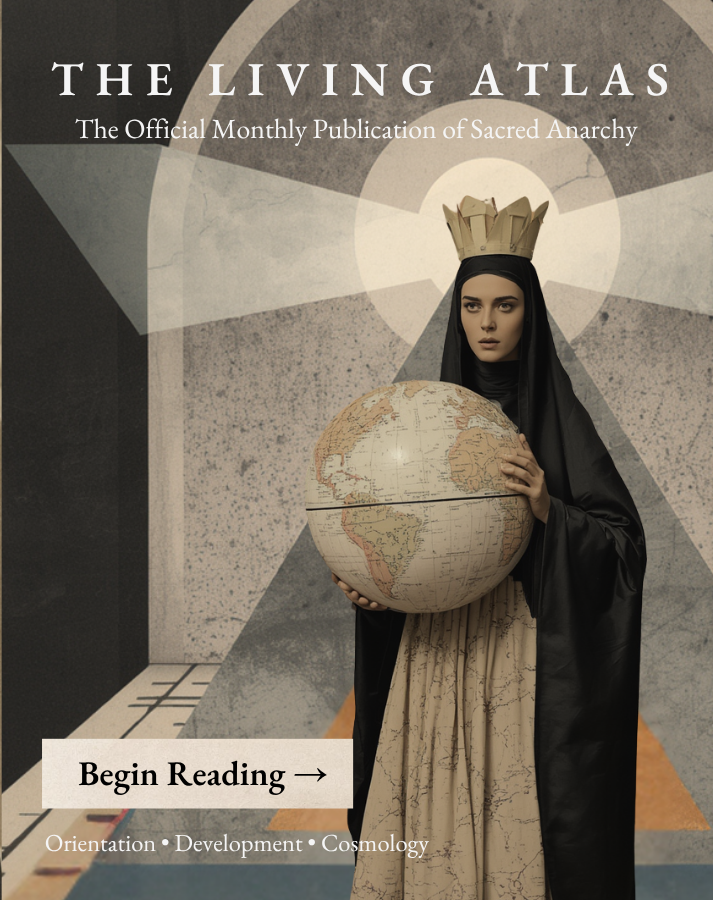
The Living Atlas is the official monthly publication of Sacred Anarchy and the primary point of entry into this cosmology. Each issue explores a single foundational concept through historical orientation, developmental analysis, and cosmological integration, allowing the larger architecture to reveal itself one volume at a time.
If this article raised more questions than it answered, it has done exactly what it was designed to do. The Living Atlas is where those questions continue.
If you're already reading The Living Atlas and want to move deeper into the mechanics behind the published work, the Keeper of the Keys Archive extends the cosmology through advanced transmissions and ongoing development.
Nothing here asks for agreement.
It asks only to be read carefully.