
The Seeker
Term: The Seeker
Category: Cultural & Psychological Structures
Definition
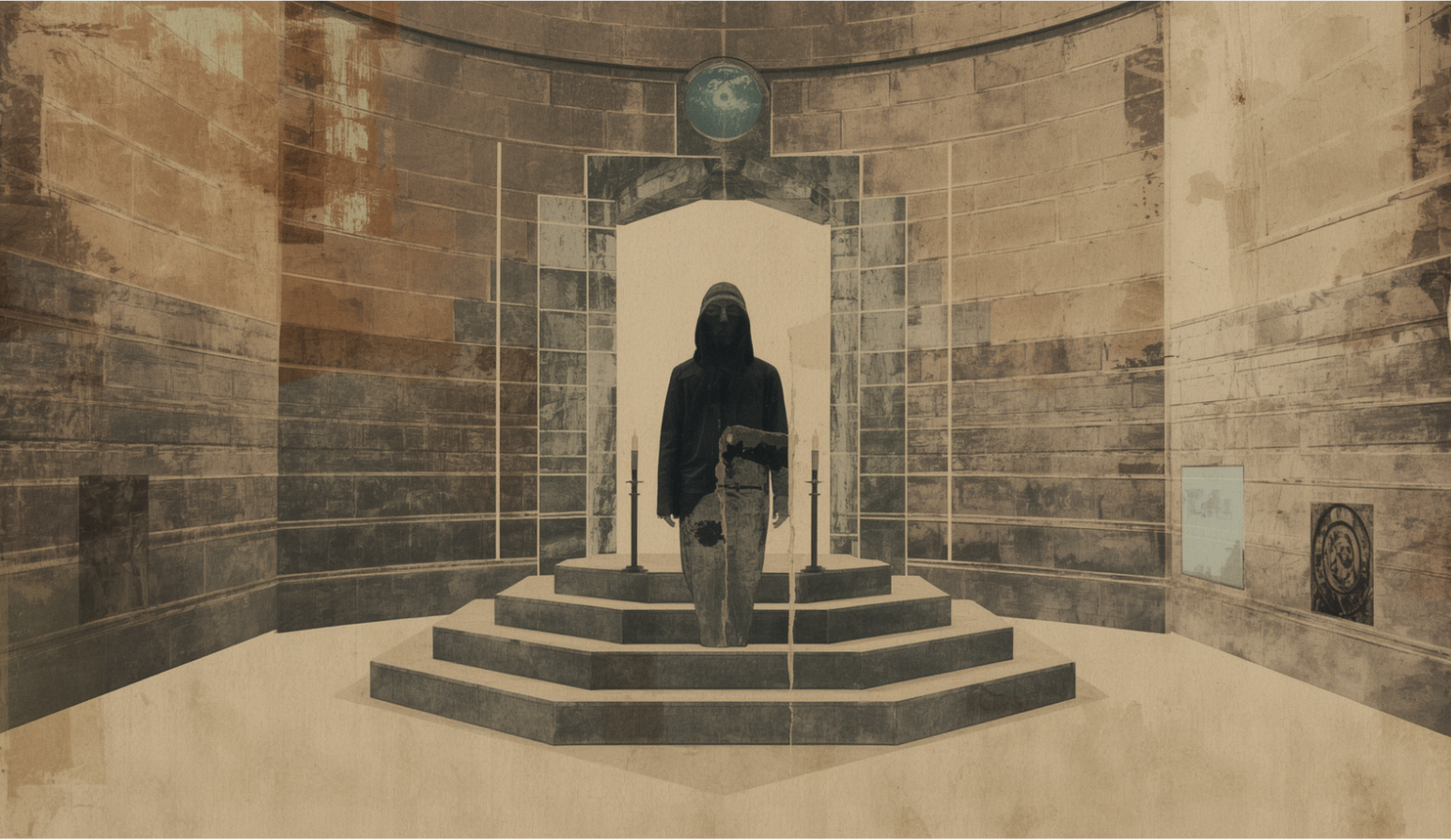
The Seeker refers to the identity structure organized around the continual pursuit of knowledge, truth, or enlightenment. Within the Sacred Anarchy framework, the seeker functions as a psychological role that keeps individuals searching within systems rather than recognizing the structures that organize the search itself.
⸻
Field Context
Spiritual traditions frequently encourage individuals to identify as seekers—people who are on a lifelong journey toward greater awareness, wisdom, or awakening. Books, teachers, retreats, and practices are often framed as tools that help the seeker advance along this path.
While curiosity and exploration can lead to meaningful insights, the seeker identity can also become a stable role within spiritual culture. Instead of questioning the frameworks that organize the search, individuals may remain focused on finding the next teaching, method, or authority that promises deeper understanding.
In this way, the act of seeking itself becomes a permanent orientation.
⸻
Structural Function
The seeker identity maintains continuous movement within spiritual and philosophical systems. By encouraging individuals to search indefinitely for answers, teachings, or experiences, the role sustains engagement with the structures that claim to provide guidance.
Because the seeker believes that fulfillment lies somewhere ahead—through another teacher, practice, or revelation—the underlying architecture of the system often remains unquestioned.
This dynamic allows spiritual environments to maintain participation without resolving the fundamental questions that initiated the search.
⸻
Relevance to the Great Work
Within the Sacred Anarchy framework, the seeker identity eventually reveals its limitation when the search itself becomes the structure that prevents recognition. As long as the individual remains oriented toward finding something outside themselves, the interpretive systems guiding the search remain intact.
The Great Work involves recognizing when the identity of the seeker has become another narrative that sustains participation within the same structures. As signal coherence stabilizes, the need to continually search for authority or meaning begins to dissolve, allowing perception to move beyond the role of the seeker.
Through this shift, remembrance replaces the endless pursuit of answers.
⸻
Related Articles
Kundalini Awakening Explained (And What Most Teachings Miss)
What Controls Your Identity? (And How It Gets Hijacked)
You’re Not Missing a Strategy—You’re Running the Wrong Operating System
⸻
Continue the Inquiry
The Keeper of the Keys Archive is a growing collection of audio transmissions designed to deepen fluency in the language, architecture, and mechanics explored throughout the Lexicon.

⸻
Related Terms
⸻
Sacred Anarchy References
Books
Field Operations

What you've just read is not a standalone article.
It is one fragment of a much larger cartography devoted to field mechanics, containment structures, intermediary systems, and the conditions required to exit them. Every essay published here belongs to the same architecture. Nothing exists in isolation.
These articles are intended to introduce individual ideas. The complete worldview emerges only when those ideas are assembled into a coherent landscape.
That landscape is The Living Atlas.

I'm Angel Quintana, creator of Sacred Anarchy and The Occult Château, and author of this body of work.
The Living Atlas is the official monthly publication of Sacred Anarchy and the primary point of entry into this cosmology. Each issue explores a single foundational concept through historical orientation, developmental analysis, and cosmological integration, allowing the larger architecture to reveal itself one volume at a time.
If this article raised more questions than it answered, it has done exactly what it was designed to do. The Living Atlas is where those questions continue.
If you're already reading The Living Atlas and want to move deeper into the mechanics behind the published work, the Keeper of the Keys Archive extends the cosmology through advanced transmissions and ongoing development.
Nothing here asks for agreement.
It asks only to be read carefully.