
Identity for Sale: The Curated Self and the Commercialization of Identity
There was a time when marketing belonged primarily to products. Businesses competed for attention, advertisements promoted what was being sold, and branding remained something that happened outside the individual. Today, that boundary has become far less clear. Across social media, professional networking, entrepreneurship, and even everyday relationships, people are increasingly encouraged to think of themselves as something to be positioned, refined, and made more valuable. Success is often measured not only by what someone creates, but by how effectively they present themselves.
This shift is so familiar that it rarely attracts scrutiny. Building a personal brand, cultivating an image, and remaining relevant are widely accepted as practical necessities rather than cultural developments worthy of investigation. Yet beneath these ordinary behaviors lies a deeper question. What happens when the logic of the marketplace no longer stops at products, but begins organizing identity itself?
Within the Sacred Anarchy framework, every maintenance condition feeds Amenta in a particular way. The purpose of this investigation is not to criticize commerce or self-presentation. It is to examine what kind of participation emerges when identity becomes something to package, position, and continually maintain.
The Marketplace Didn’t Stop at Products
How Commerce Learned to Sell Identity
Commerce has always adapted to what people value most. At one time, businesses competed by making products that were faster, stronger, cheaper, or more reliable than the alternatives. Quality and utility drove competition because the product itself was the primary object of exchange. Over time, however, commerce discovered that products were only part of what people were actually buying.
A fitness program no longer promises better health alone. It promises discipline. Luxury goods promise success. Minimalism promises sophistication. Organic food promises virtue. Increasingly, products function as symbols that communicate who someone is, or who they hope to become. The purchase extends beyond ownership into identity.
This shift changed the marketplace in a profound way. Products eventually satisfy because they can be acquired. Identity does not. It remains open to continual refinement, comparison, and improvement. A person who believes they are purchasing a better version of themselves rarely reaches a point where the transaction feels complete. There is always another image to embody, another standard to pursue, another identity to acquire.
The marketplace did not stop at selling products. It learned to sell people back to themselves. In doing so, commerce expanded beyond the exchange of goods and quietly entered the construction of identity itself.
From Commerce to Market Identity
The evolution happens gradually. Commerce begins by selling products, then expands into services, experiences, and lifestyles. Eventually, it reaches something far more personal. Identity itself becomes part of the marketplace. The transition is so ordinary that it rarely feels like a transition at all. It simply begins to seem like the way successful people participate in the world.
For an artist, creating the work is no longer enough. They are expected to build a recognizable brand, cultivate an online presence, and remain consistently visible. A business owner spends as much time refining a personal image as developing the business itself. A professional carefully curates every profile photo, biography, and public opinion because each one contributes to how they are perceived. Even job seekers are encouraged to think of themselves as products that must be packaged and differentiated in a competitive market.
None of these activities are inherently problematic. Many of them serve practical purposes. The deeper shift occurs when managing perception quietly becomes more important than expressing what is true. Attention begins flowing toward visibility rather than authorship. The work remains, but increasing amounts of energy are devoted to maintaining the person who represents it.
This is where a new maintenance condition emerges. Within the Sacred Anarchy framework, it can be understood as Market Identity: the version of the self constructed primarily for exchange, recognition, and perceived value. Unlike authorship, which originates from direct expression, Market Identity continually asks how the self can become more desirable to an audience.
Without consciously choosing it, the product is no longer simply what someone creates. The product becomes the person creating it. The marketplace has crossed a boundary. It is no longer marketing goods. It is quietly teaching people to market themselves.
Identity becomes merchandise the moment it is shaped primarily for recognition rather than expression.
Field Observation
When Market Logic Becomes Internal
The most significant change does not happen in the marketplace. It happens within the individual. Once market logic becomes internal, it begins shaping decisions long before anything is shared with the world. The question is no longer simply what to create. It becomes what will attract attention, gain approval, or perform well. The audience enters the creative process before the work itself has fully emerged.
This marks the difference between expression and curation. Expression begins with what is true and allows the work to find its own form. Curation begins by anticipating reception. It edits before it reveals. It asks which parts of the self should be highlighted, softened, hidden, or amplified in order to produce the desired response. The work becomes increasingly organized around prediction rather than discovery.
The shift is visible almost everywhere. A writer hesitates to publish an idea because it may not align with their established brand. An entrepreneur avoids exploring a new direction because it could confuse their audience. A creator chooses topics that are likely to generate engagement rather than those they genuinely feel compelled to investigate. None of these decisions appear dramatic in isolation, yet together they gradually train identity to respond to the marketplace before responding to itself.
Eventually, curation no longer feels like a strategy. It feels like common sense. Visibility becomes easier to trust than coherence because visibility offers immediate feedback. This is how the condition sustains itself. The audience quietly replaces authorship, and presentation begins organizing participation before expression ever has the opportunity to emerge.
The Endless Maintenance of the Curated Self
When identity enters the marketplace, it begins behaving less like a person and more like inventory. Inventory cannot sit untouched on a shelf. It must be updated, refreshed, repositioned, and made attractive enough to compete with everything surrounding it. The same logic quietly begins shaping the self. Relevance becomes something to preserve rather than something that naturally emerges from meaningful work.
This maintenance appears in subtle ways. There is pressure to post consistently so people do not forget you. Opinions are carefully timed to remain visible. Achievements are documented because silence risks becoming invisibility. Even periods of rest can begin to feel like falling behind, not because the work has stopped, but because the presentation of the work has paused.
The result is a life increasingly organized around perceived value. Instead of asking whether something is worth creating, people begin wondering whether it will strengthen their position, increase engagement, or reinforce the identity they have already established. Every decision carries an additional calculation. How will this affect the way I am seen?
Nothing ever feels finished because inventory is never finished. It is continually evaluated against changing markets, changing trends, and changing expectations. The work is no longer simply to create. The work becomes preserving the market value of the self. In this condition, maintenance quietly replaces authorship, and identity becomes another asset that must be continually managed.
The Black Box operating system does not ask, “Who are you?” It asks, “Who can you become that others will recognize?”
Field Observation
Market Logic Enters Consciousness
When Commerce Becomes a Way of Participating
The Curated Self does not remain inside the marketplace. It follows people home. What begins as a commercial strategy gradually becomes a way of interpreting everyday life. Within the Black Box operating system, market logic no longer organizes only transactions. It begins organizing participation itself.
Experiences become opportunities to build a personal narrative. Reading a book is no longer simply about encountering an idea. It becomes something worth displaying. Travel becomes content before it becomes remembrance. Relationships become connections to leverage. Conversations become networking. Even moments of solitude can be interrupted by the question of whether they are valuable enough to share. Life is no longer only lived. It is continually evaluated for its exchange value.
This is one of Amenta’s most efficient maintenance conditions because it rarely feels imposed. People willingly participate. They learn to assess themselves the way a marketplace would. Am I relevant? Am I visible? Am I growing? Am I falling behind? The Black Box quietly replaces direct experience with continuous self-evaluation until market logic begins to feel indistinguishable from common sense.
Commerce has always shaped economies. The Curated Self reveals something much deeper. The marketplace has entered consciousness. Once identity is measured by visibility, relevance, and perceived value, participation itself becomes the product. And Amenta no longer needs to convince people to maintain the system. They begin maintaining it for themselves.
Authorship Cannot Be Marketed
There is nothing inherently wrong with presenting your work. Every creator eventually has to decide how their work will reach the people it is meant to serve. The deeper question is whether, somewhere along the way, the work quietly stepped aside and you became the thing being marketed instead.
Within the Sacred Anarchy framework, this is the distinction between authorship and the Curated Self. Authorship begins with expression. The Curated Self begins with perception. One asks, What wants to be expressed? The other asks, How can I become more desirable? They may appear similar from the outside, but they organize participation in fundamentally different ways.
The Curated Self promises visibility, influence, opportunity, and growth. What it quietly requires in return is perpetual maintenance. Identity must remain relevant. Opinions must remain current. Visibility must be sustained. Value must be protected. There is no point of completion because market value is never something that can finally be possessed. It must continually be defended.
This is what makes the condition so effective within Amenta. The Black Box operating system does not require people to believe they are trapped. It simply teaches them to experience themselves as something that must always be improved, positioned, and made more valuable. The parasite does not care whether the marketplace rewards or rejects the effort. It only cares that the effort never ends.
The Curated Self feeds Amenta by teaching people to measure identity through market value. The marketplace did not become transformative when it learned to sell better products. It became transformative when it learned to sell identities, and most profitable when people began maintaining them themselves.
Related Articles
• Why You Feel Disconnected From Your Origin
• What Is “Crossing the Abyss?”
• The Roadmap Out of Hell Was Hidden. Until Now.
Glossary
• Signal

What you've just read is not a standalone article.
It is one fragment of a much larger cartography devoted to field mechanics, containment structures, intermediary systems, and the conditions required to exit them. Every essay published here belongs to the same architecture. Nothing exists in isolation.
These articles are intended to introduce individual ideas. The complete worldview emerges only when those ideas are assembled into a coherent landscape.
That landscape is The Living Atlas.

I'm Angel Quintana, creator of Sacred Anarchy and The Occult Château, and author of this body of work.
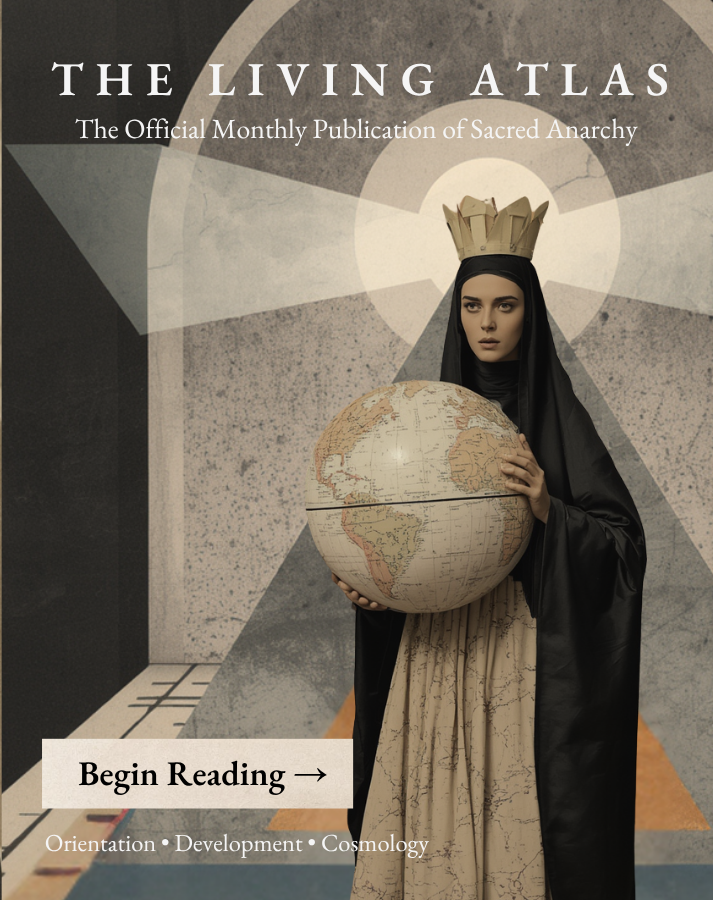
The Living Atlas is the official monthly publication of Sacred Anarchy and the primary point of entry into this cosmology. Each issue explores a single foundational concept through historical orientation, developmental analysis, and cosmological integration, allowing the larger architecture to reveal itself one volume at a time.
If this article raised more questions than it answered, it has done exactly what it was designed to do. The Living Atlas is where those questions continue.
If you're already reading The Living Atlas and want to move deeper into the mechanics behind the published work, the Keeper of the Keys Archive extends the cosmology through advanced transmissions and ongoing development.
Nothing here asks for agreement.
It asks only to be read carefully.