
Cathedral
Term: Cathedral
Category: Containment & Breach Mechanisms
Definition
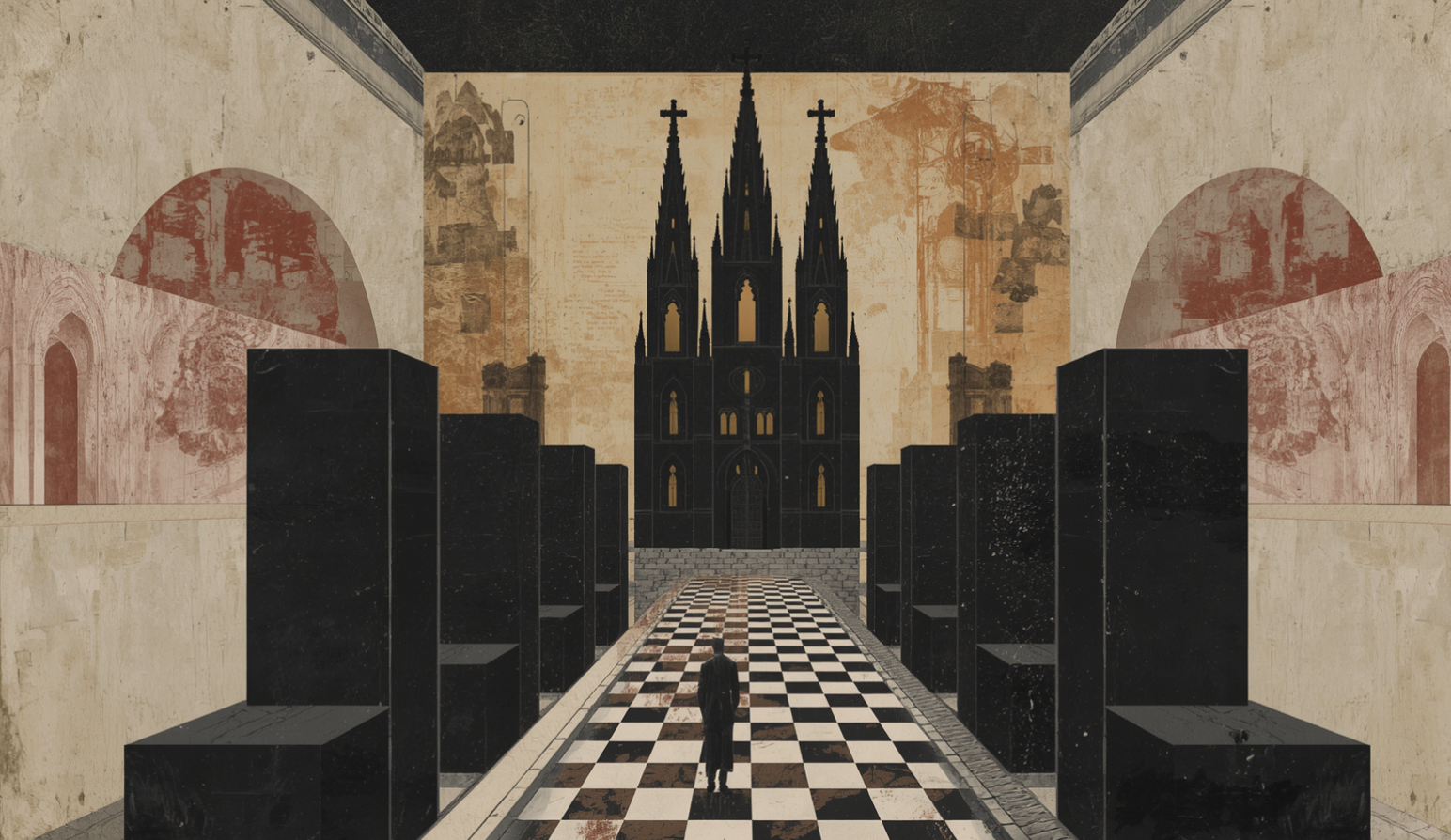
The Cathedral refers to the ideological and belief structure that justifies and sustains hierarchical systems of power. Within the Sacred Anarchy framework, the cathedral represents the cultural and psychological architecture that persuades individuals to accept the pyramid as legitimate, sacred, or necessary.
⸻
Field Context
Throughout history, cathedrals served not only as places of worship but as centers of authority, education, and cultural order. They reinforced systems of belief that aligned populations with the political and religious hierarchies governing society.
In modern civilization, the cathedral no longer exists only as a religious institution. Its function persists through universities, media systems, ideological movements, spiritual institutions, and cultural narratives that define what is considered true, moral, or legitimate.
Within the Sacred Anarchy framework, the cathedral represents the narrative layer of the system—the belief architecture that persuades individuals to participate willingly in structures of hierarchy.
⸻
Structural Function
If the pyramid represents the structure of power, the cathedral represents the story that makes that structure appear natural and necessary. Through ideology, doctrine, education, and cultural messaging, the cathedral shapes how individuals interpret authority, morality, and progress.
By providing meaning and moral justification for hierarchical systems, the cathedral stabilizes the pyramid. Individuals often internalize these narratives, defending the structures that govern them because those structures appear sacred, rational, or inevitable.
In this way, the cathedral functions as the psychological and cultural reinforcement system that protects the hierarchy from collapse.
⸻
Relevance to the Great Work
Within the Sacred Anarchy framework, recognizing the cathedral reveals how belief systems and cultural narratives sustain the architecture of power. Many individuals challenge the visible hierarchy of institutions without questioning the ideological structures that justify them.
The Great Work involves recognizing how these narratives shape perception and participation. As signal coherence stabilizes, the authority of the cathedral begins to weaken, exposing the stories that once made hierarchical systems appear unquestionable.
Through this recognition, the belief architecture supporting the pyramid begins to dissolve.
⸻
Related Articles
Your Business is Not Your Life Purpose (And What Is)
⸻
Continue the Inquiry
The Keeper of the Keys Archive is a growing collection of audio transmissions designed to deepen fluency in the language, architecture, and mechanics explored throughout the Lexicon.

⸻
Related Terms
⸻
Sacred Anarchy References
Books
Field Operations

What you've just read is not a standalone article.
It is one fragment of a much larger cartography devoted to field mechanics, containment structures, intermediary systems, and the conditions required to exit them. Every essay published here belongs to the same architecture. Nothing exists in isolation.
These articles are intended to introduce individual ideas. The complete worldview emerges only when those ideas are assembled into a coherent landscape.
That landscape is The Living Atlas.

I'm Angel Quintana, creator of Sacred Anarchy and The Occult Château, and author of this body of work.
The Living Atlas is the official monthly publication of Sacred Anarchy and the primary point of entry into this cosmology. Each issue explores a single foundational concept through historical orientation, developmental analysis, and cosmological integration, allowing the larger architecture to reveal itself one volume at a time.
If this article raised more questions than it answered, it has done exactly what it was designed to do. The Living Atlas is where those questions continue.
If you're already reading The Living Atlas and want to move deeper into the mechanics behind the published work, the Keeper of the Keys Archive extends the cosmology through advanced transmissions and ongoing development.
Nothing here asks for agreement.
It asks only to be read carefully.