
Pyramid
Term: Pyramid
Category: Containment & Breach Mechanisms
Definition
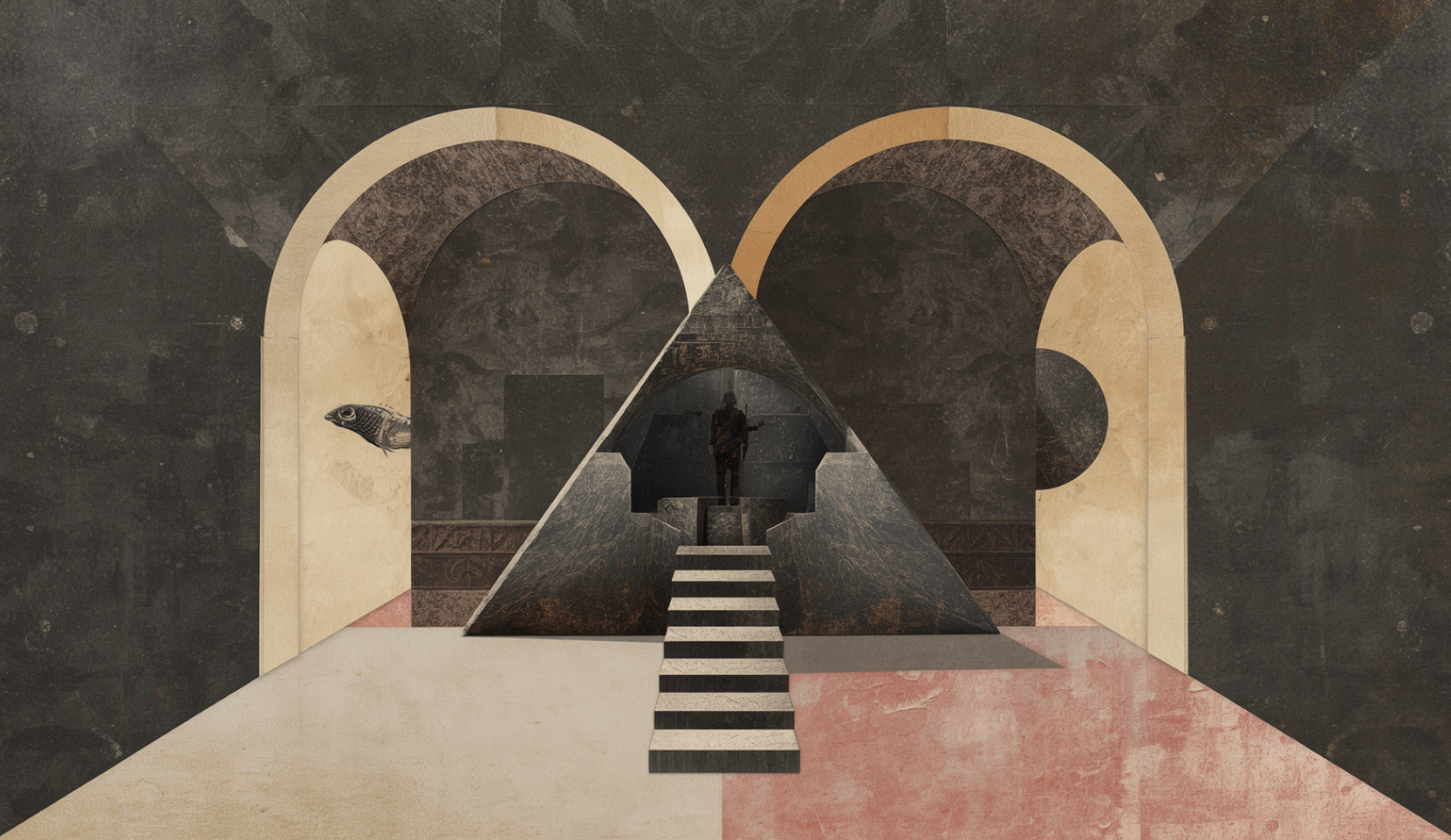
The Pyramid refers to the structural architecture of hierarchy through which power, authority, and identity are organized within Amenta. Within the Sacred Anarchy framework, the pyramid represents the vertical system of control that concentrates authority at the top while organizing participation and obedience through the layers below.
⸻
Field Context
Throughout history, pyramids have appeared as both physical monuments and symbolic representations of power. Ancient civilizations used pyramidal structures to signify divine kingship, cosmic order, and centralized authority.
In modern society, the pyramid persists as a structural model for institutions, corporations, governments, and ideological systems. Authority flows from the top downward, while the majority of participants operate within the lower levels that sustain the system.
Within the Sacred Anarchy framework, the pyramid is not simply an ancient symbol but a visible representation of how hierarchical systems organize power and participation.
⸻
Structural Function
The pyramid functions as the structural diagram of hierarchical order. Each layer of the structure depends on the participation of those beneath it while reinforcing the authority of those above.
Identity, validation, and institutional narratives stabilize the lower levels of the structure, ensuring that individuals continue participating in the system that concentrates power toward the top. Because the pyramid appears stable and natural, its architecture often goes unquestioned.
Through this structure, authority can remain centralized while participation appears voluntary.
⸻
Relevance to the Great Work
Within the Sacred Anarchy framework, recognizing the pyramid reveals how hierarchy organizes power through identity, belief, and institutional authority. Many cultural systems present hierarchy as necessary for order or progress, reinforcing the assumption that power must flow vertically.
The Great Work exposes the structural nature of this architecture. As signal coherence stabilizes, the perceived legitimacy of hierarchical systems weakens, allowing individuals to recognize the mechanisms through which authority has been organized and maintained.
Through this recognition, the pyramid is no longer experienced as a natural structure but as a symbolic architecture that can be understood, observed, and ultimately dismantled.
⸻
Related Articles
The Spiral and the Pyramid: Two Incompatible Models of Participation
⸻
Continue the Inquiry
The Keeper of the Keys Archive is a growing collection of audio transmissions designed to deepen fluency in the language, architecture, and mechanics explored throughout the Lexicon.

Related Concepts
⸻
Sacred Anarchy References
Books
Field Operations

What you've just read is not a standalone article.
It is one fragment of a much larger cartography devoted to field mechanics, containment structures, intermediary systems, and the conditions required to exit them. Every essay published here belongs to the same architecture. Nothing exists in isolation.
These articles are intended to introduce individual ideas. The complete worldview emerges only when those ideas are assembled into a coherent landscape.
That landscape is The Living Atlas.

I'm Angel Quintana, creator of Sacred Anarchy and The Occult Château, and author of this body of work.
The Living Atlas is the official monthly publication of Sacred Anarchy and the primary point of entry into this cosmology. Each issue explores a single foundational concept through historical orientation, developmental analysis, and cosmological integration, allowing the larger architecture to reveal itself one volume at a time.
If this article raised more questions than it answered, it has done exactly what it was designed to do. The Living Atlas is where those questions continue.
If you're already reading The Living Atlas and want to move deeper into the mechanics behind the published work, the Keeper of the Keys Archive extends the cosmology through advanced transmissions and ongoing development.
Nothing here asks for agreement.
It asks only to be read carefully.